TesboLBM · GPU lattice Boltzmann
Molten metal. Open air. Hero water.One engine. Hundreds of times faster.
A GPU-native lattice Boltzmann solver built around free surfaces. Fill a sand mould, a die or a ceramic shell and watch it solidify. Put a car body in the wind. Flood a film set. Same engine, results identical to the bit on one GPU or several.
Measured: hundreds of times vs a single CPU core, 55× vs the whole 18-core CPU · Six casting processes · 145 materials · Multi-GPU, bit-for-bit
Filling, heat transfer and solidification — solved on the GPU”
REAL CASTING
A full casting cycle, on a production part
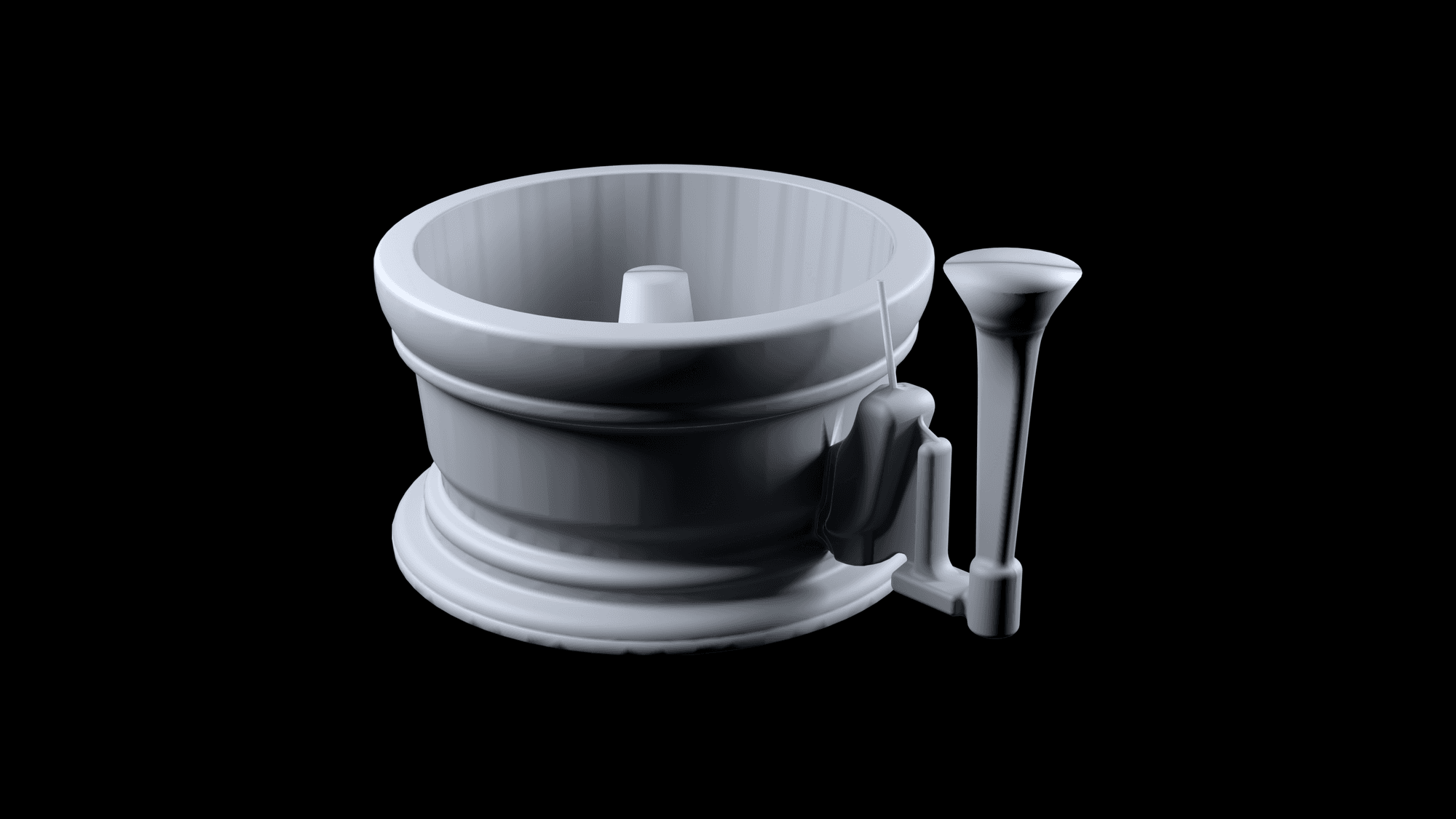
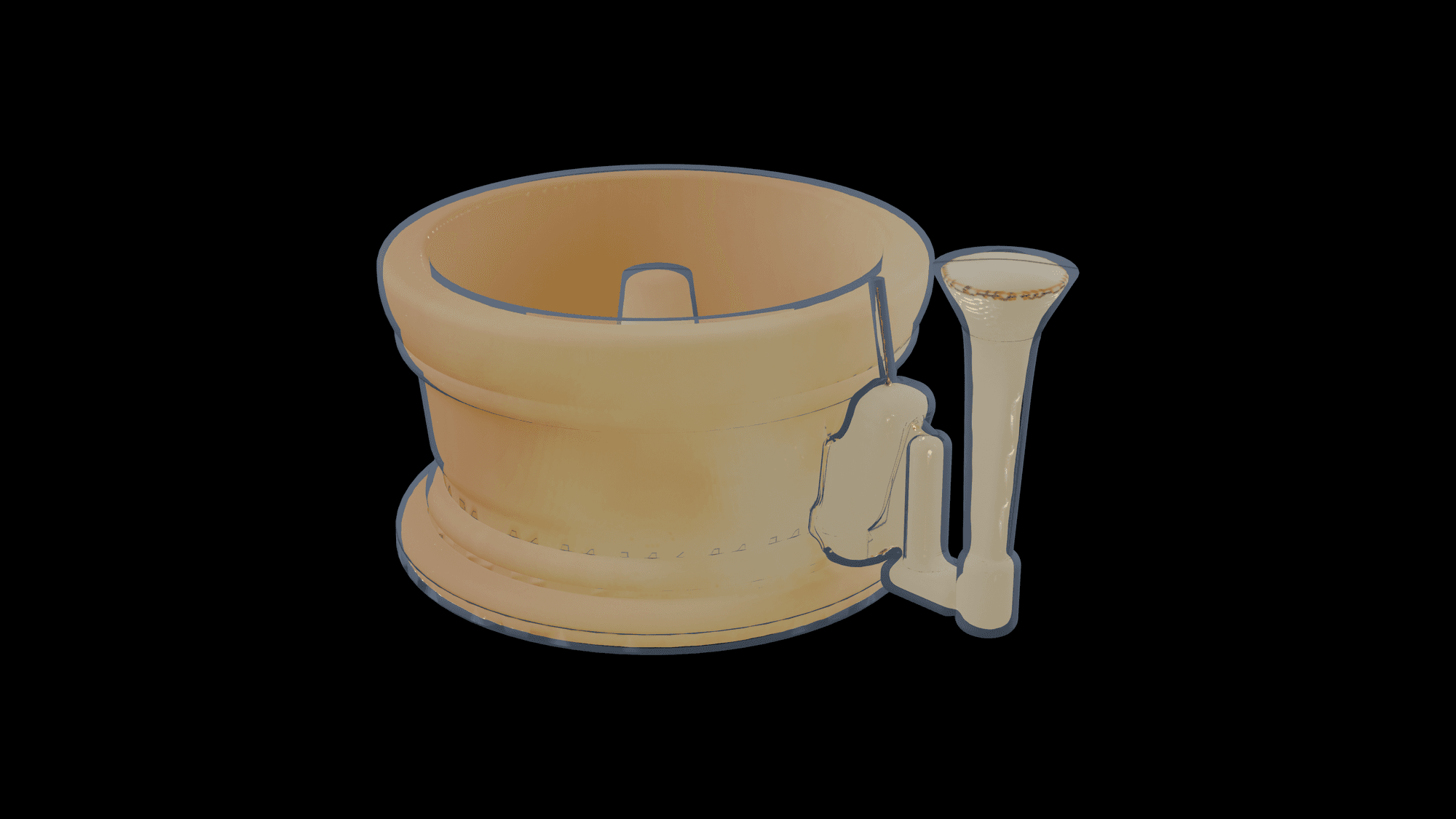
Filling and solidification of a wheel-hub casting, run on the customer's own geometry. One continuous shot: the two stages are thermally coupled, so solidification starts from the temperature field filling ended with.
Wheel-hub casting, AlSi7Mg — filling then solidification, coloured by temperature. The last bright spot under the central riser is where the casting solidifies last.
GPU PERFORMANCE
Numbers, not slogans
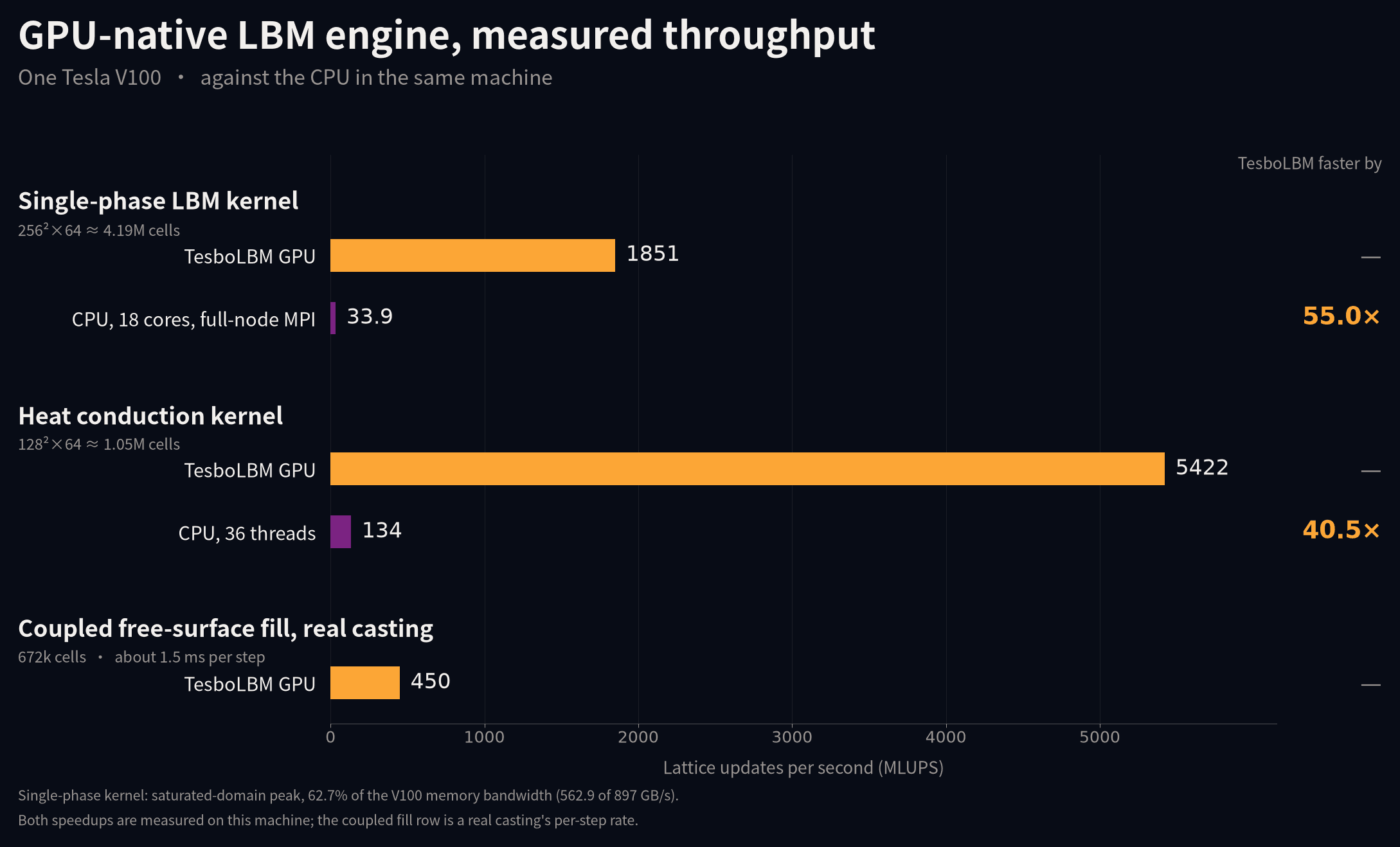
Every figure below is measured on one machine: a single Tesla V100 against that same machine's CPU, running the same kernel. Nothing is scaled or extrapolated.
- 0×
Single-phase LBM kernel
1851 MLUPS on one V100 — 62.7% of the card's memory bandwidth — against 33.9 MLUPS for all 18 CPU cores of the same machine. Grid 256² × 64, about 4.19M cells.
- 0.0×
Heat conduction kernel
5422 MLUPS against 134 MLUPS on 36 CPU threads, both sides running the same arithmetic. Grid 128² × 64, about 1.05M cells.
- 0.0%
Of the card's memory bandwidth
562.9 of the V100's 897 GB/s reached by the single-phase kernel. Lattice Boltzmann is memory-bound, so this is the ceiling that matters.
WHERE THE GAP COMES FROM
Bandwidth, not clock speed. Lattice Boltzmann is memory-bound, so a handful of cores already saturate a CPU socket: on the same machine, going from 1 core to 18 buys only 8.3× (4.1 to 33.9 MLUPS, 45% parallel efficiency). The V100 run reaches 62.7% of the card's memory bandwidth. Adding CPU cores does not close that gap.
The 1851 MLUPS figure is the single-phase kernel peak on a saturated domain. A coupled free-surface fill on a real casting runs at roughly 450 MLUPS effective, about 1.5 ms/step on 672k cells, because it carries more fields and more passes per step. Actual throughput depends on the casting, the grid and the hardware.
CAPABILITIES
What TesboLBM does
Process
- Filling: LBM with free-surface tracking, sub-grid turbulence, adaptive time step
- Heat transfer and solidification: latent heat, interfacial resistance, multiple solid materials
- Filling into solidification, thermally continuous
- Gravity sand casting
- Low-pressure die casting
Physics
- Cavity back-pressure and venting, per-body permeability (vents, risers, chills, cores)
- Natural convection: buoyancy plus mushy-zone drag
- Real solid-fraction curve fs(T), importable from alloy phase data
- Interfacial heat transfer coefficient calibrated from measured cooling curves
- Simulation versus measurement comparison, with error and correlation metrics
- Multi-component alloy property data
Defect prediction
- Shrinkage porosity, Niyama-graded
- Hot-tearing tendency
- Secondary dendrite arm spacing (SDAS)
Platform & workflow
- CUDA GPU backend
- CPU backend with MPI domain decomposition
- Multi-GPU on one machine, results identical to a single card
- Built-in command-line mesher for filling and thermal meshes
- Adaptive refinement on the thermal mesh
- Static configuration checker before a run
- Numerical robustness on finer meshes
Core Technical Features
Standard 3D D3Q19 lattice model, balancing computational speed and numerical accuracy
Advanced Multi-Relaxation Time (MRT) collision operator, maintaining strong numerical stability at high Reynolds numbers and in strongly turbulent flow
Integrated Large Eddy Simulation (LES) Smagorinsky subgrid model to accurately resolve fine turbulent flow structures
High-fidelity transient Free Surface Tracking to deeply capture liquid splashing, back-folding, and air pocket entrainment during mold filling
Fully temperature-coupled multi-physics solver with temperature-dependent physical properties (density, heat capacity, thermal conductivity) and latent heat release
Sophisticated Interface Heat Transfer Coefficient (IHTC) boundary conditions, modeling transient heat exchange between the casting and sand molds, metal molds, chills, risers, and sand cores
Scientific Specifications & Governing Equations
MRT Boltzmann Evolution Equation with Body Force
Collision relaxation occurs in the moment space, decoupling shear and bulk viscosities. Combined with body forces (such as gravity), this dramatically outperforms traditional single-relaxation time (BGK) models.
LES Subgrid Scale Turbulence Model
Dynamically calculates subgrid eddy viscosity based on the second invariant of the local strain rate tensor, delivering extreme adaptability for turbulent shear flows.
Industrial Application Scenarios
Gravity Sand Casting
Simulates complex gating systems, runners, and deep cavities. Predicts liquid front merging, gravity-driven filling profiles, and transient thermal gradients.
High- & Low-Pressure Die Casting
Captures fast metal flows near mold walls, chills, and cores. Accurately predicts high-speed air entrainment, dead zones, turbulent slag inclusions, and riser compensation.
Thermal Control & Solidification
Couples temperature-dependent physics with latent heat release to model solid fraction evolution. Predicts the influence of cooling channels on solidification rates, helping reduce shrinkage defects.
Interested in TesboLBM Simulation Technology?
Cast is an annual, node-locked licence. Request a quote for a production machine, or talk to us about an engineering job.