TesboAI · AI-assisted CFD
Talk to the solver.Trust the answer.
Describe the case in plain words; TesboAI builds it, runs it on TesboFlow and checks every number before you see it — the model never invents a value. Underneath, neural surrogates trained on real solver fields turn hours of design sweeps into seconds, all on a local model, so your data never leaves the building.
Neural operators · Physics-informed models · LLM agents · Local model, data stays on-site
AI, built into the CFD loop
Most AI-for-CFD tools sit beside the solver and shuttle data across separate hardware. TesboAI is designed differently: because it is built on our own GPU-native solver, neural models are intended to run inside the solve loop on the same GPU, without cross-device data movement. From offline surrogates to physics-constrained, differentiable simulation, we treat AI as a native part of the solver rather than an afterthought.
Talk your way
through a simulation
Ask, follow up, change a condition, compare options — keep going as long as you like. The agent handles the intent and the orchestration; every number comes out of our GPU solver and has to pass its checks before you get a conclusion.
A replay of a real session. Every number is produced by the GPU solver and judged by its checks — none of the figures in a conclusion are generated by the AI.
Shown, not told.
Every figure and frame below is a real solver or predicted field.
- 10×
Lower field error
Field-to-field super-resolution: relative L2 from 0.1–0.19 for an interpolation baseline down to about 0.01, trained on 25 samples.
- 92.3%
Mean gain over interpolation
Averaged over the held-out set, same run. Zero-shot to an unseen resolution the operator also degrades less than a comparable CNN: 0.063 against 0.084.
- 1.8×
Faster inference in the solver
Per inference call at 4M cells, running in the solver's own GPU memory. Across separate devices, 45–65% of that call is spent moving data.
Neural-operator super-resolution
A single Fourier Neural Operator learns a coarse-to-fine field mapping that transfers across mesh resolutions without retraining.
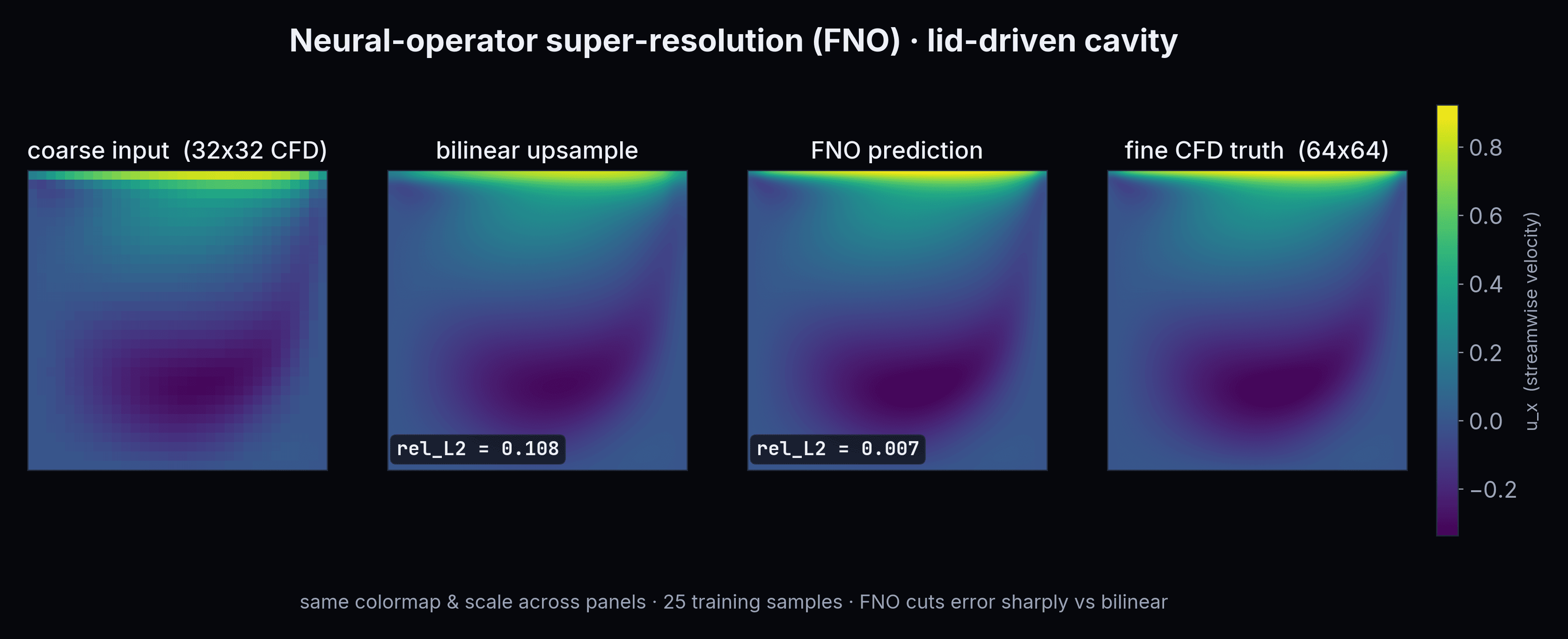
Resolution-independent — train coarse, evaluate fine.
Differentiable physics
Embedding the governing equations into the training loop, so the model learns in a way that respects the physics.
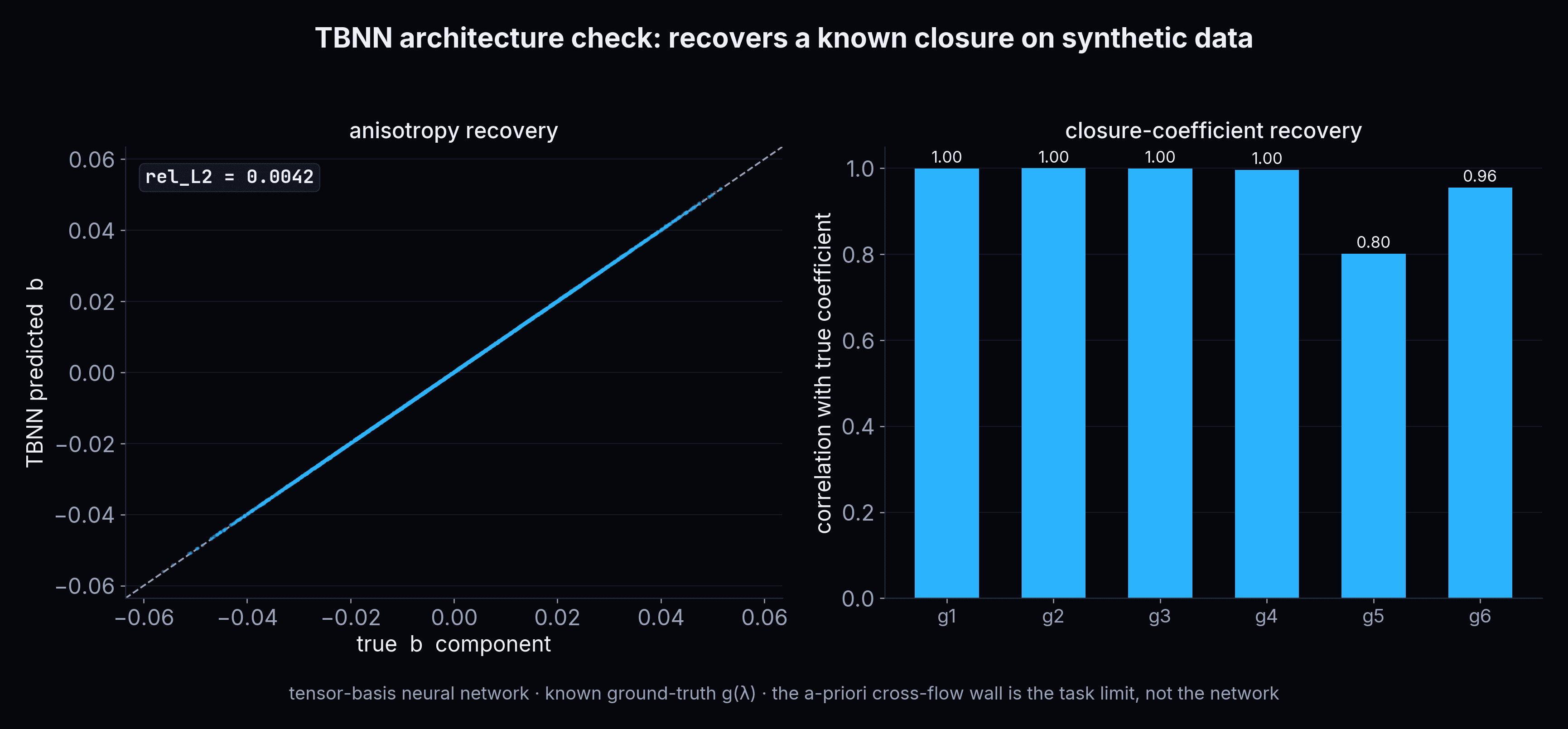
Data-driven turbulence closure (TBNN)
Learning turbulence closures from high-fidelity data, with physical invariances built into the model.
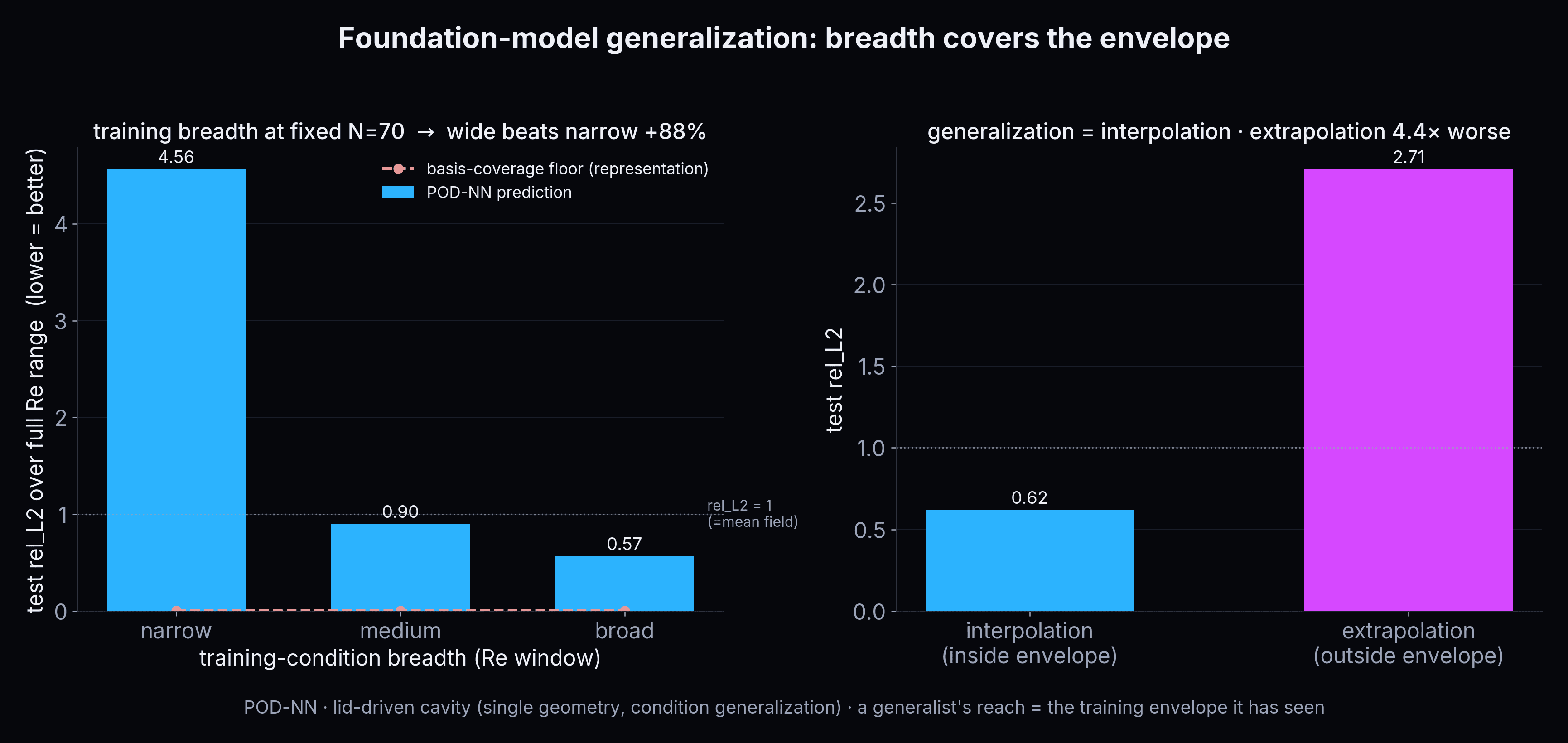
Foundation models · breadth to generalization
How broadly a model is trained shapes how well it generalizes across conditions.
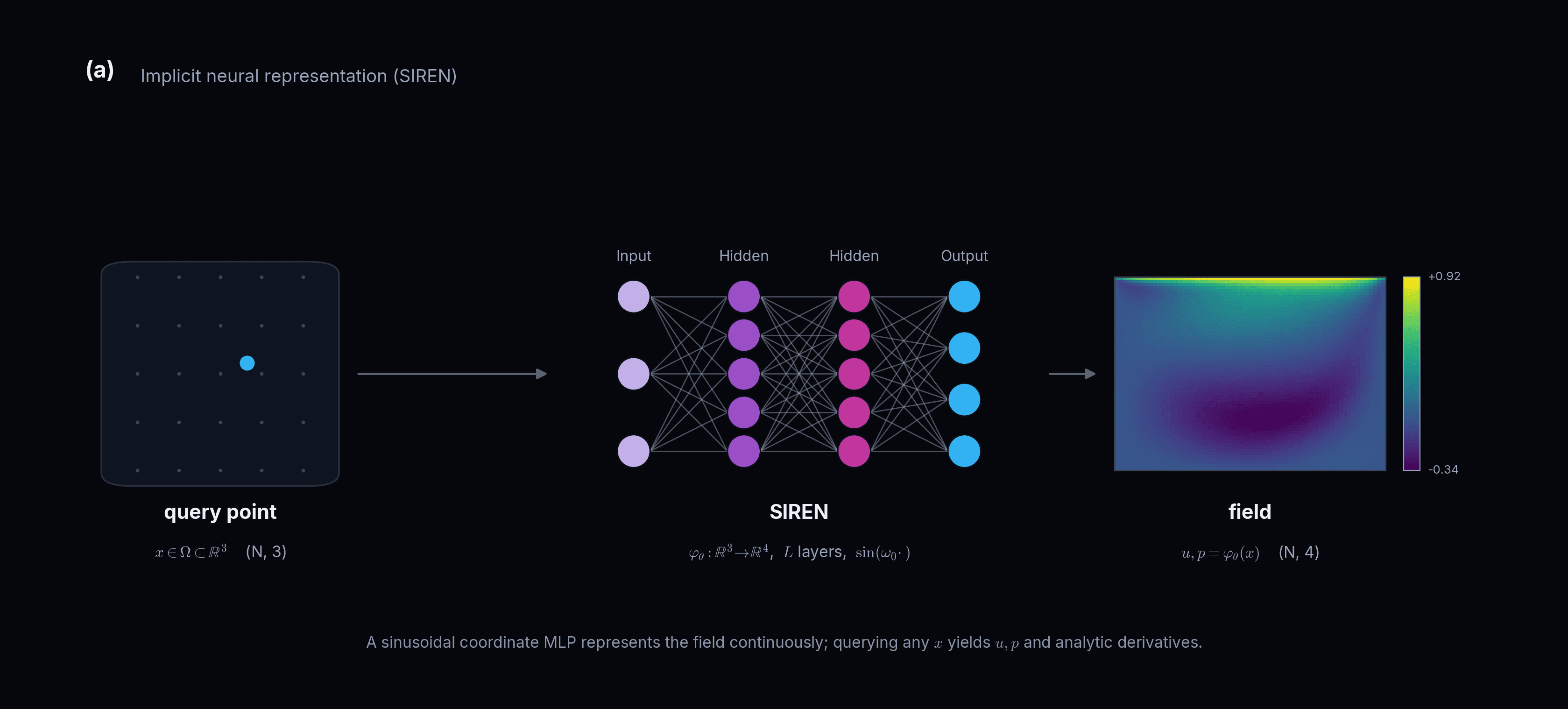
SIREN — mesh-free fields
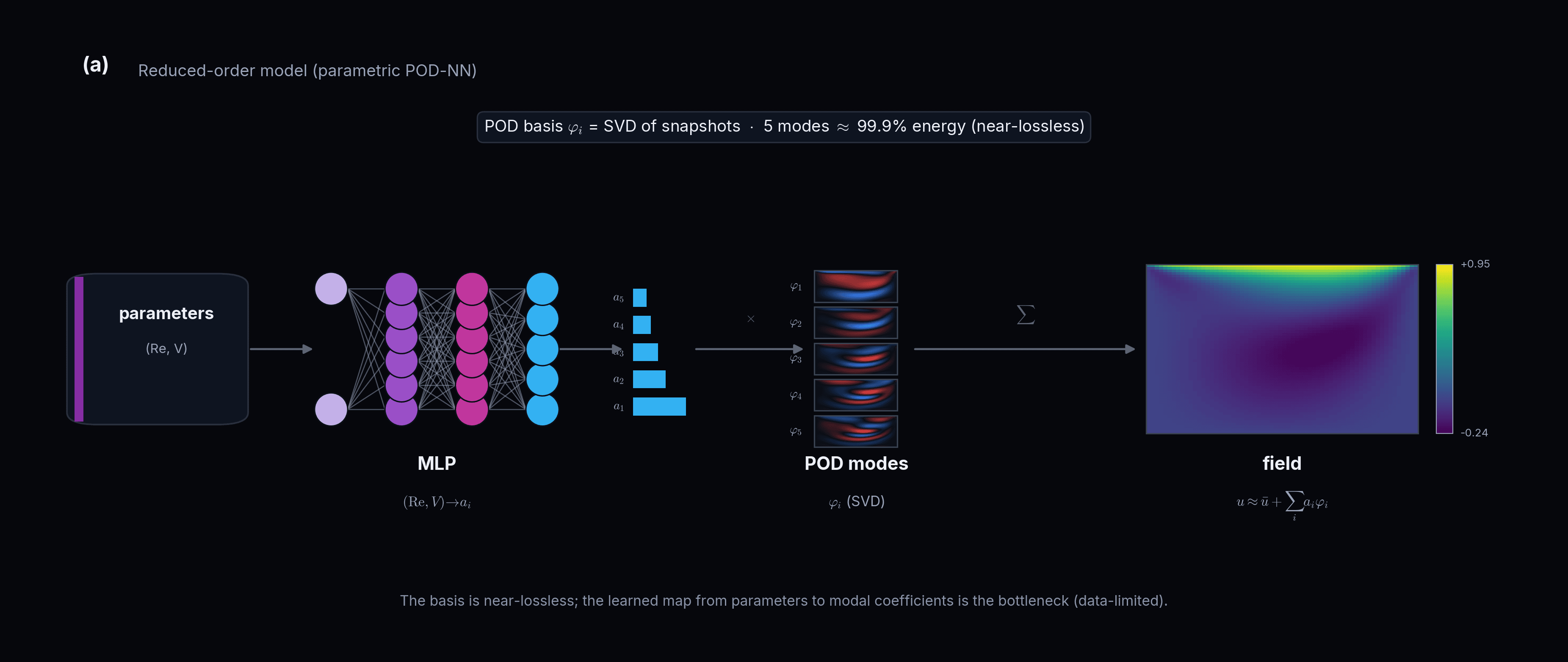
POD / POD-NN reduced-order models
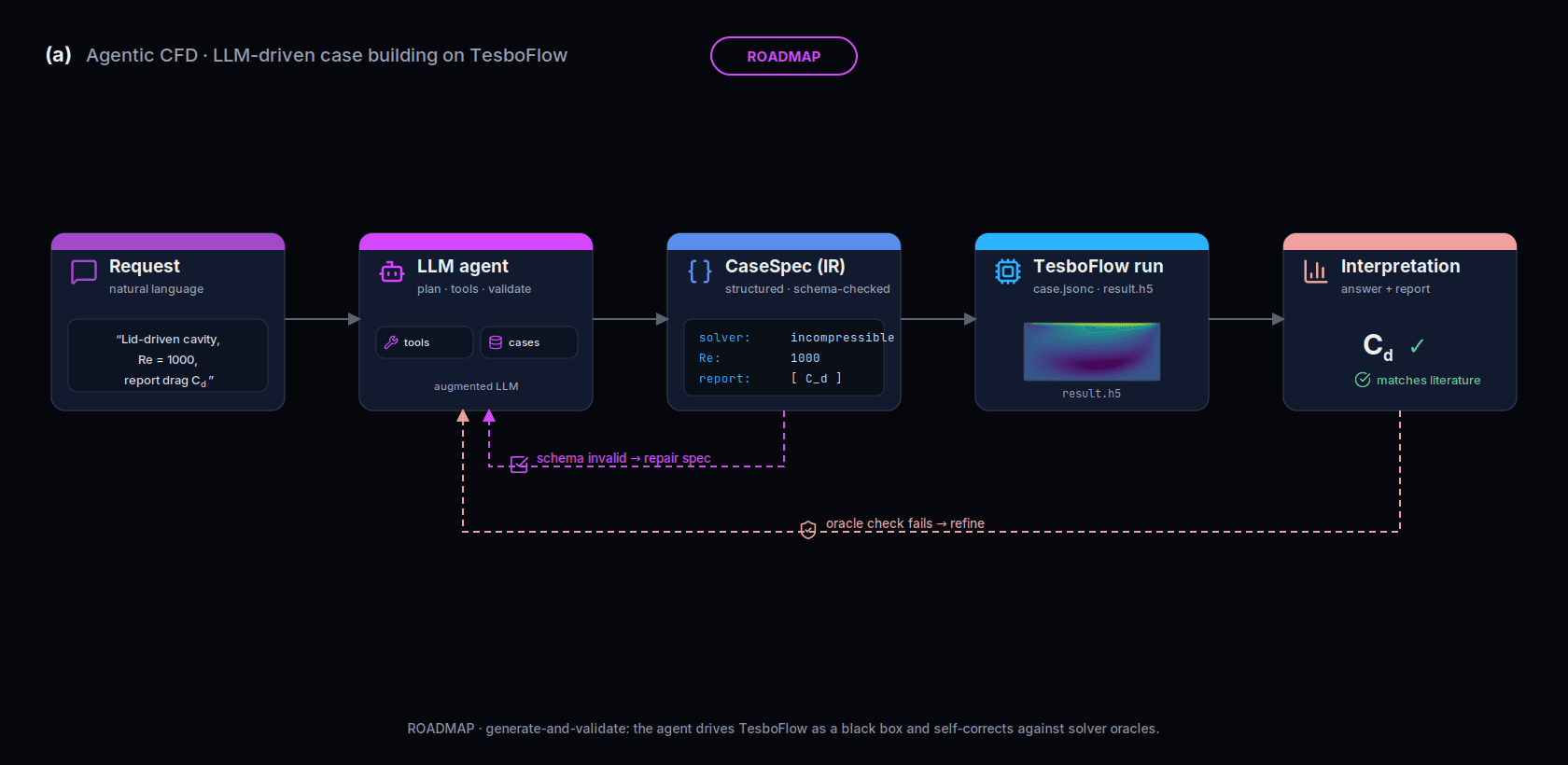
Agentic CFD — LLM-driven cases
Scope: 2D benchmark flows, research prototypes.
AI is the umbrella, not the method
We use the word AI only as the field name. In practice we work across four distinct method classes, and we are explicit about which one applies.
Non-neural statistical and dimensionality-reduction methods such as POD.
Deep neural networks — neural operators, coordinate networks, tensor-basis closures, autoencoders.
Deep learning combined with numerical methods (adjoint, PDE residuals) — a category of its own, not pure ML.
Generative models for natural-language case setup and orchestration — not numerical models.
Core Capabilities
Design-Speed Inference
Once trained, AI surrogates target near real-time evaluation, turning design iterations from hours into interactive cycles.
End-to-End Automation
From sampling to inference and visualization, the pipeline is designed to run without manual CFD setup.
Domain-Specific Models
Tailored models for different applications and physics, so outputs stay trustworthy and deployable in their target domain.
Physics-Consistent
Physics constraints such as divergence-free conditions are built into training to keep predictions physically coherent, not just visually plausible.
From surrogate to differentiable
Our work advances along increasing levels of integration between AI and the solver.
Comparison with Traditional CFD
Traditional CFD
- Domain knowledge required
- Mesh generation and solver setup: hours to days
- Design space exploration is prohibitively expensive
AI-Assisted CFD Design
- No manual setup; one-click inference
- Per evaluation: milliseconds to seconds
- Interactive design cycles with instant feedback
Build with TesboAI
Exploring AI-assisted CFD design, or have a problem that needs a custom surrogate? We'd like to hear from you.